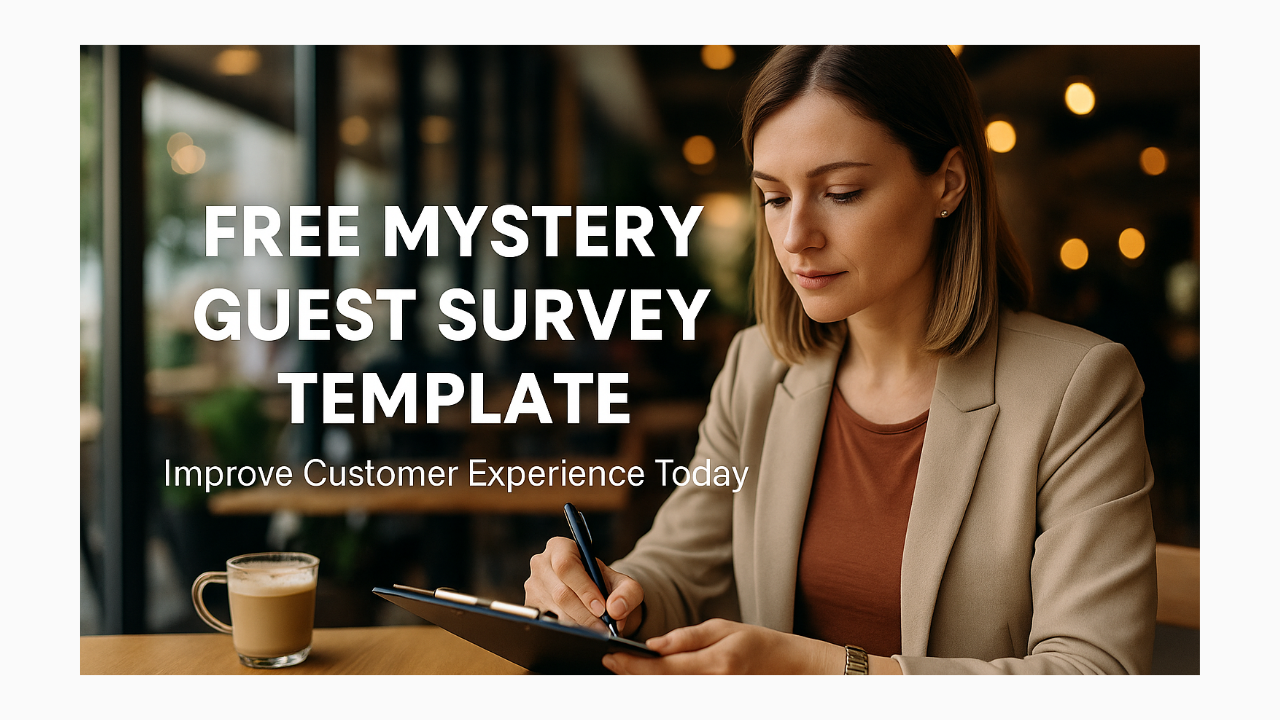
A mystery guest survey is one of the simplest ways to see your business exactly as a customer does. Whether you run a café, a leisure venue, a retail store, a gym, or a service business, this guide (and the free template below) will help you measure what matters: first impressions, service, environment, speed, accuracy, and how complaints are handled.
This resource is completely free to use, print, and adapt. If you’d like a bespoke version tailored to your brand, touchpoints, and goals, you’re welcome to reach out. I’ll happily build one with you.
What is a “Mystery Guest” (and why it works)
A mystery guest (sometimes called a mystery shopper) is a normal customer who visits anonymously, follows a simple checklist, and scores the experience. The goal isn’t to “catch people out.” It’s to spot gaps, confirm strengths, and prioritise improvements with real-world evidence.
Why it’s effective:
- It captures first-hand reality, not opinions from the boardroom.
- It focuses teams on what the customer actually sees and feels.
- It produces clear actions, not wishy-washy sentiments.
- It’s quick to run and easy to repeat (monthly or quarterly).
What you’ll get (free)
- A printable Mystery Guest Survey Template covering:
- Pre-visit info & enquiry
- Arrival & first impressions
- Service interaction (empathy, product knowledge, ownership)
- Environment & facilities (cleanliness, accessibility, safety)
- Transaction & payment (speed, accuracy, options)
- Complaint handling (if applicable)
- Aftercare & follow-up (receipt, feedback invite, loyalty)
- Overall score, NPS, highlights & improvements
- Clear scoring from 1 (Very Poor) to 5 (Excellent), with space for notes.
- A section for top 3 strengths and top 3 improvements — so the output becomes an action plan.
Download the free Mystery Guest Survey Template (.docx)
Download the free Mystery Guest Survey Template (.PDF)
How to run a mystery guest visit (step-by-step)
- Set the objective
Decide what you want to learn. Is your focus first impressions? Speed at the till? Cleanliness? Complaint handling? Note it at the top of the survey. - Pick the right person
Choose someone who can be objective. They don’t need to be a QA expert, just observant and fair. - Choose a typical time
Visit when normal customers visit: a busy Saturday, an early weekday, or school-run hours, whatever reflects reality for you. If you can, run two visits at different times to compare. - Act like a normal customer
No clipboards on show. No “insider” questions. Order, browse, ask a simple question, maybe use the toilets. If there’s a queue, wait like everyone else. - Record details immediately
Complete the survey right after the visit while it’s fresh. Add real examples (e.g. “Greeted within 3 seconds by James, very warm tone”). - Turn findings into an action list
From the “Top 3 improvements” section, agree who owns each one, what success looks like, and a date to check progress. Keep it tight and realistic.
Scoring that leads to action (not arguments)
Use the 1–5 scale consistently:
- 1 = Very Poor (serious fail; needs urgent action)
- 2 = Poor (below standard; noticeable to most customers)
- 3 = Okay (meets basics; room to improve)
- 4 = Good (above standard; consistent)
- 5 = Excellent (stand-out; model example)
- N/A if not relevant
Tip: Average the section scores to create a simple Customer Experience Index out of 5. Track it monthly or quarterly to see trends. Pair it with NPS (0–10) for a fuller picture.
What to do with the results
- Debrief your team constructively
Share the top 3 strengths first. What you want to protect. Then the top 3 improvements. Keep the tone solution-focused: “Here’s what we’re going to try for two weeks and review.” - Fix easy wins immediately
Examples: signage clarity, door area clutter, “greet within 10 seconds,” cleaner rota on weekends, receipt offered every time. - Tackle the bigger rocks
If themes repeat (e.g., slow service during peak times), look at staffing levels, processes, or training. Mystery guest data lets you make evidence-based decisions. - Repeat on a rhythm
Monthly for busy venues, quarterly for smaller sites. The goal is steady improvement, not one big audit and forget.
Mystery Guest code of conduct (keep it fair)
- Be safe and respectful. Don’t disrupt normal operation.
- Pay as a normal customer would and keep your receipt.
- Don’t record personal data without a lawful reason.
- If an issue is severe (safety, safeguarding), escalate to a manager immediately, don’t wait.
Who this template works for
- Hospitality & leisure: cafés, restaurants, attractions, cinemas, gyms, bowling, karting.
- Retail & petrol stations: forecourts, convenience stores, boutiques.
- Service businesses: salons, vets, clinics, local trades with customer reception.
If your business has guests or customers, this survey will fit, and I can tailor it to specific touchpoints (e.g., bookings, kit hire, memberships, accessibility, upsell rules, complaint escalation).
Make it bespoke to your brand (optional)
Every business is different. If you’d like a tailored version aligned to your layout, brand standards, service steps, and KPIs, I’m happy to help. I have many years of experience in Mystery Guest Visit for one of the top leisure businesses int he UK.
The problem faced by many businesses is that they actually don’t know what they want to find out, not really. For example, ‘Making sure Customer Service is up to scratch’ is far too broad. You need to dig into what that looks like and the appropriate questions to look for during the visit. That’s where I can help.
Typical customisations include:
- Venue-specific checkpoints (e.g., “track briefing started on time,” “pump area clean,” “queue under 3 minutes”)
- Brand tone & standards (greeting scripts, offers, loyalty)
- Weighted scoring and KPI alignment
- Multi-site roll-up sheets and trend tracking
Want a bespoke version? Send me a message with your business type, opening hours, and 3–5 things you care most about. I’ll suggest a customised survey you can pilot next week.
FAQs
How often should we run mystery guest visits?
Start monthly for busy venues or quarterly for smaller sites. Increase during change periods (new menu, refurbishment, new manager).
Should staff know it’s happening?
They shouldn’t know the exact dates, but do explain the why: it’s about improving the customer experience, not catching people out.
What’s a good score?
Aim for 4.0+ as a consistent benchmark. Anything under 3.5 means there are noticeable issues customers will feel. If you are doing a % score, I would score 80-89% as good, 90%+ as great.
Do we need NPS as well as the survey?
Yes. NPS (0–10 “likelihood to recommend”) complements the checklist by capturing overall sentiment.
Download the free template
- Download the free Mystery Guest Survey Template (.docx)
- Download the free Mystery Guest Survey Template (.PDF)
Use it as-is, or tweak it for your venue. If you’d like me to create a bespoke version, just reach out and tell me what you need.
Leave a Reply